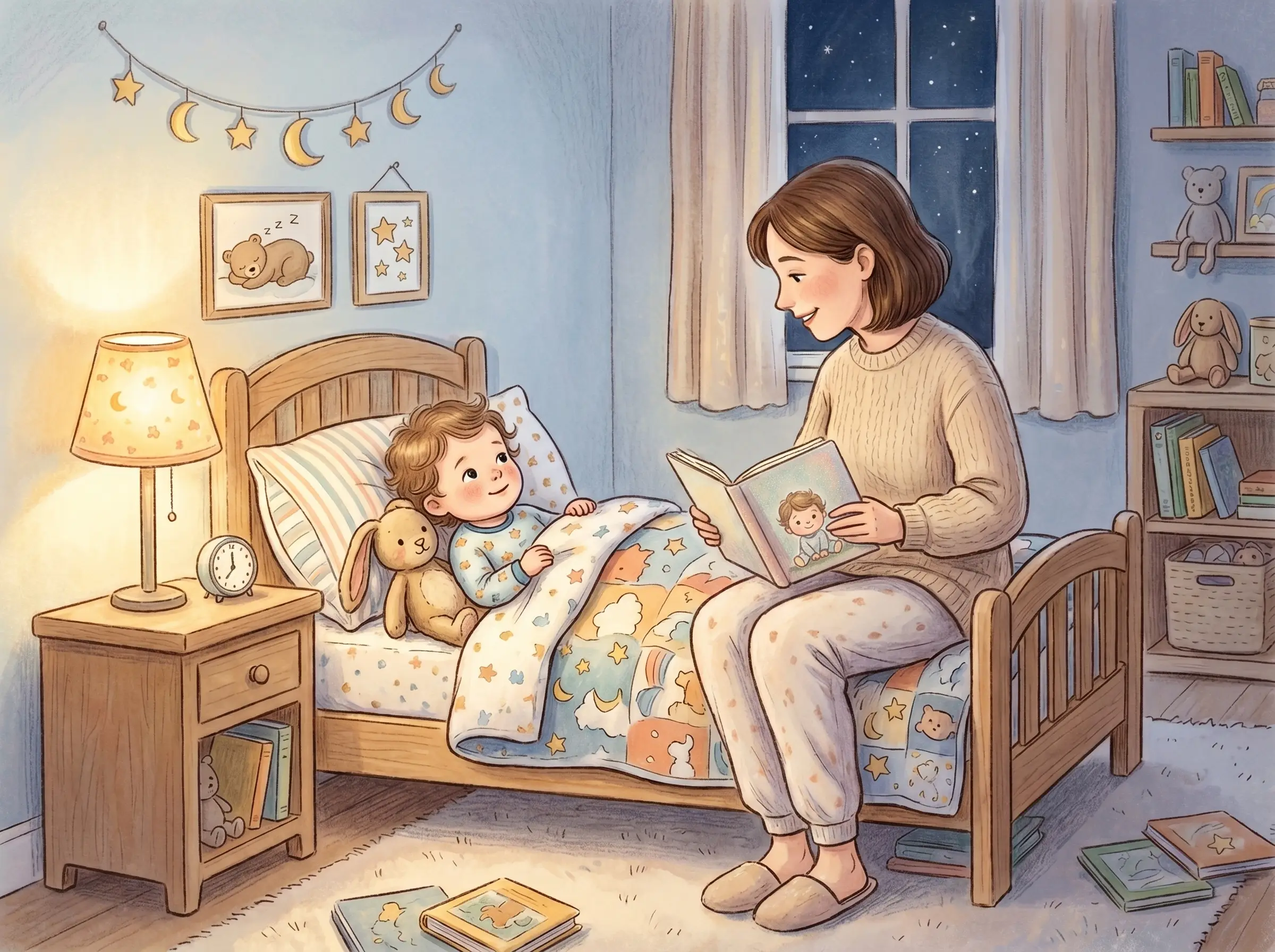
Every parent of a toddler knows the scene: it’s 7:30 PM, your little one is wired, and you’re desperately hoping that one more story will finally do the trick. But not all bedtime stories are created equal — especially for toddlers between ages 1 and 4, whose brains are developing at lightning speed.
Here’s what science and thousands of parents have learned about what makes a truly great toddler bedtime story.
Why Toddler Bedtime Stories Are Different
Toddlers aren’t just small children. They’re in a uniquely intense phase of brain development. Between ages 1 and 4:
- Vocabulary explodes from ~50 words at 18 months to 1,000+ words by age 3
- Emotional regulation is still forming — stories help them process feelings safely
- Sleep transitions are hardest at this age — a predictable story routine signals the brain that sleep is coming
A bedtime story for a toddler isn’t just entertainment. It’s a neurological anchor for the night.
What Makes a Good Bedtime Story for a 1–2 Year Old
At 12–24 months, toddlers are pre-readers with short attention spans and a hunger for repetition. The best stories at this age:
- Are short — 3 to 5 minutes maximum
- Have simple, rhythmic language — “Goodnight moon, goodnight room” style
- Feature one main character doing simple, familiar things
- End with sleep — the character going to bed models the behavior you want
Repetition isn’t boring to a 1-year-old. It’s reassuring. The same story, night after night, becomes a sleep trigger.
The secret weapon: Use your child’s name. Even at 18 months, toddlers react more strongly to stories featuring themselves as the main character. Their brain lights up differently — and they calm down faster.
What Works for a 2–3 Year Old
By age 2, toddlers have language and big emotions — but not yet the ability to regulate them. The best stories for this age:
- Name emotions explicitly — “Lily felt scared, but then she felt safe”
- Have a simple problem and resolution — conflict and comfort in 5 minutes
- Include familiar places — home, the park, grandma’s house
- Let the child be the hero — not a passive observer
At this age, personalized stories — where your child’s name, their stuffed animal, their pet are woven into the story — are dramatically more effective than generic fairy tales. Research from the University of Toronto found that children engaged for 40% longer with stories that featured familiar elements from their own lives.
What Works for a 3–4 Year Old
Three and four-year-olds are entering the “why” phase — they want logic, they want to understand the world, and they want longer stories with more complex characters. The best stories at this age:
- Have a beginning, middle, and end with a clear arc
- Feature characters with distinct personalities — not just “a bunny” but “a brave bunny who was afraid of the dark”
- Include gentle life lessons — sharing, kindness, courage
- Allow participation — “What do you think happens next?”
Interactive storytelling at age 3–4 doesn’t keep them awake longer. It actually helps them wind down, because it channels their active imagination into the story rather than into jumping on the bed.
The Voice Factor: Why Who Reads Matters as Much as What
Here’s something most parents don’t realize: for toddlers, the voice delivering the story matters as much as the content.
Studies from Stanford’s Center for Sleep Sciences show that the familiar voice of a caregiver — not a professional narrator, not an audiobook — triggers the most significant cortisol reduction in toddlers before sleep. Your voice is literally a sleep drug for your child.
This is why apps that narrate stories in a stranger’s voice — however pleasant — miss the point. And it’s why parents who travel for work, or grandparents who live far away, often feel their absence most acutely at bedtime.
The Personalized Story Advantage
Traditional bedtime books are wonderful — but they have one big limitation: they’re the same every night. For toddlers who demand novelty while also craving routine, personalized AI bedtime stories offer something remarkable:
- Fresh content every night — a new adventure, a new problem to solve
- Consistent characters — your child, their pet, their favorite toy
- Familiar voice — narrated by mom, dad, or grandma, even if they’re far away
- Right length — tuned to your child’s age and attention span
Apps like HuggleTales let parents record their voice once and generate unlimited personalized stories narrated in that exact voice — so a traveling dad can be present at bedtime every night, and a grandparent living abroad can read to their grandchild every evening without a phone call.
Practical Tips: Building the Perfect Toddler Bedtime Story Routine
- Start at the same time every night — consistency is more important than the story itself
- Dim the lights before you begin — signals the brain that sleep is coming
- Use a calm, slow voice — even exciting parts should be told softly
- Let them choose — toddlers who feel in control of the story selection resist bedtime less
- End the story in the room — don’t let “one more story” become a loop
The goal isn’t just to get through the story. It’s to make bedtime a ritual your toddler looks forward to — which makes the whole night easier for everyone.
HuggleTales creates personalized bedtime stories narrated in your own voice — perfect for toddlers aged 1–4. Try your first story free →