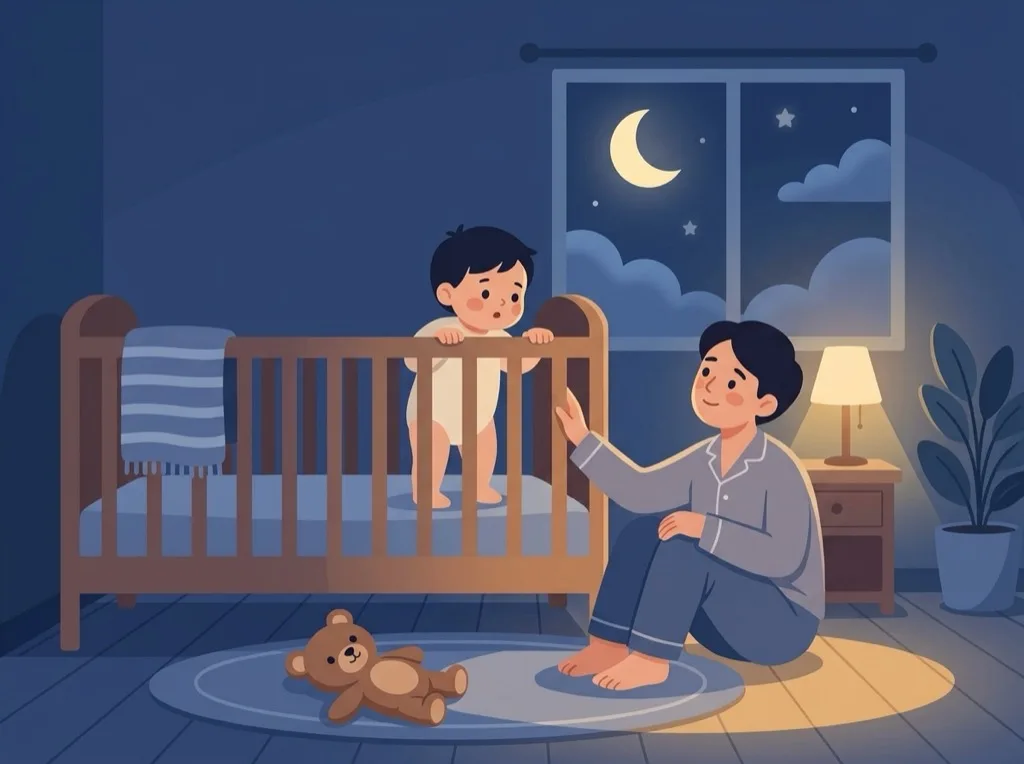
It happens overnight. A child who has slept through for months is suddenly up at 2 AM, wide awake and furious about it. Nothing changed. No teeth, no fever, no holiday. And you find yourself standing in a dark hallway at three in the morning wondering what you did wrong.
You did nothing wrong. What you are looking at is almost certainly a sleep regression — and it is one of the most misunderstood phases of early childhood.
What a Sleep Regression Actually Is
Source: American Academy of Sleep Medicine
The name is misleading. Nothing is going backwards.
A sleep regression is a stretch of two to six weeks in which a child who was sleeping reliably starts waking at night, fighting bedtime, or dropping naps — not because sleep broke, but because the brain is busy building something new. A developmental leap costs energy, and the sleep system pays for it first.
Three things are happening at once:
- New skills rehearse at night. A brain that just learned to pull to stand or to say twenty new words practises during light sleep. The child genuinely wakes up wanting to try it.
- Sleep cycles are maturing. Between roughly four months and three years the architecture of children’s sleep is repeatedly rebuilt. Every rebuild means more brief awakenings.
- Awareness outruns self-soothing. The child now notices that you left the room. The skill of getting back to sleep alone hasn’t caught up yet.
“A regression is not a loss of sleep skills. It’s a temporary cost of gaining other skills — and it ends on its own.”
The Sleep Regression Ages
Source: Journal of Sleep Research / Cleveland Clinic
These windows are approximate. Children arrive at each one on their own schedule, and no child gets all of them.
4 months — the only permanent one. This is the one that isn’t really a regression at all: newborn sleep permanently reorganises into adult-like cycles with distinct light and deep stages. The old ability to be transferred asleep into a cot disappears — not for a few weeks, but for good. Most families find this the hardest, precisely because it doesn’t reverse.
8–10 months — the mobility one. Crawling, pulling up, standing. The child wakes at the top of a light-sleep cycle already on their feet at the cot rail, and then can’t work out how to lie back down. Separation anxiety usually peaks here too.
12 months — the nap wobble. Often not a night-sleep problem but a nap one. Many children look ready to drop to a single nap at twelve months and genuinely aren’t until fifteen to eighteen. Cutting too early produces overtiredness, which produces night waking.
18 months — the will one. Language, independence and the discovery that “no” is a complete sentence. Bedtime becomes a negotiation because the child has just learned that negotiation exists.
2 years — the imagination one. Language explodes, the first real fears appear, a sibling may arrive, and the cot may turn into a bed. Toddlers this age can now imagine something that isn’t in the room — which is exactly what makes the dark newly interesting.
3 years — the last one. Nap dropping, nightmares, and full-sentence stalling (“one more story, one more water, one more question”). This is usually the shortest and the last.
How Long It Lasts
Source: Cleveland Clinic – Pediatric Sleep
Two to six weeks is the honest answer, with most families landing at three or four.
There is one important caveat, and it’s the one that catches people out: a regression that lasts longer than six weeks is usually no longer a regression. By then, whatever you did to survive it — bringing the child into your bed, feeding back to sleep, sitting on the floor until they dropped off — has become the new way your child falls asleep. The developmental leap ended; the habit stayed.
That’s not a disaster. It just means the fix is different: you’re now unwinding an association, not waiting out a phase.
What Actually Helps
Source: American Academy of Pediatrics – Healthy Sleep Habits
1. Change nothing structural. The single most common mistake is a wholesale overhaul during week one — new bedtime, new room, new method. The regression will end regardless; a rebuilt routine will not. Hold the routine you had, exactly as it was.
2. Move bedtime earlier, not later. It feels backwards. It isn’t. A child who is fighting sleep is usually overtired, and an overtired brain releases cortisol to stay upright — which makes falling asleep harder and waking easier. Twenty to thirty minutes earlier is often the whole fix.
3. Protect the naps, especially the ones you think they’ve outgrown. Most 12-month and 18-month “night waking” is a daytime problem wearing a nighttime costume.
4. Give the new skill daytime airtime. If the brain is rehearsing standing up, practise standing up and lying back down at 10 AM, on the floor, ten times, as a game. Skills that get rehearsed in daylight rehearse less at midnight.
5. Respond, but keep it boring. Go in. Reassure. Keep it dim, short and dull — no lights, no chat, no pick-up if you can avoid it. Presence without stimulation tells the brain that the night is still the night.
6. Keep the wind-down predictable. The pre-sleep sequence is the one signal that survives a regression intact. Bath, pyjamas, two books, same song, same words, lights out. When everything internal is in flux, the external order is what the child holds on to.
The Part Nobody Says Out Loud
A regression is hardest on the parent, not the child. Children come out the other side with a new skill. Parents come out of it four weeks short on sleep, having spent every evening at their least patient in front of the person they most want to be gentle with.
Two things genuinely help.
Split the nights. If there are two adults, alternate whole nights rather than each getting up twice. One broken night and one intact night beats two half-nights, every time.
Lower the bar for the routine, not its shape. On the evenings you have nothing left, the routine still needs to happen — but it doesn’t need to be performed. A story you have the energy to tell badly still works. A story you skip because you couldn’t face it is the one that costs you.
This is where a recorded voice earns its keep: the sequence stays intact and the child still hears the person they want to hear, on the night you have nothing left to give.
When It’s Not a Regression
Source: American Academy of Pediatrics
Check for the ordinary explanations before you name it a phase. Teething, an ear infection, a cold, a room that got warmer with the season, a house move, a new sibling, a first week of nursery. Any of these produces the same picture.
Talk to your paediatrician if night waking comes with snoring or pauses in breathing, if your child seems in pain, if it has run past six weeks with no sign of easing, or if the daytime child — mood, appetite, development — looks different too.
The Bottom Line
Sleep regressions are not a sign that something went wrong. They’re the visible cost of a brain doing exactly what it should. They arrive at broadly predictable ages, last two to six weeks, and end without needing to be solved.
Your job during one is smaller than it feels: keep the routine, protect the sleep pressure, respond calmly, and don’t rebuild anything while the ground is moving.
It ends. Almost always sooner than it feels like it will.
HuggleTales turns the wind-down into the one part of the evening that always works: a personalised bedtime story, narrated in your own voice, in 10 languages. Your first story is free →